Friday, May 05, 2006

The Art of Thin-Slicing


One of the books that I'm currently reading is Blink by Malcolm Gladwell. I'm not done with it yet, but so far it's been interesting...especially when one thinks of how it affects one's profession.

For me, I've obviously thought about how snap judgements affect the talent acquisition (aka recruiting) realm. And it got me to thinking...I wonder how many recruiters out there are successful at "thin-slicing" candidates (read the synopsis of Blink in the link above if you have no idea what "thin-slicing" is).

If you take what's said in the book to be generally true, it means that in the first moments of interacting with a candidate a recruiter makes their decision on whether this person is going through to the next round or not. The kicker, as Gladwell explains, is that this decision is most often times done subconsciously in the brain.

As a result, if you don't understand how to correctly thin-slice your subconscious, you might end up making some costly decisions along the way...like passing on a candidate because you make the assumption that based on their clothing, they wouldn't be able to be an all-star consultant in your firm.

Reading through this book, I realize that when it comes to recruiting, these snap judgements are one of the most costly decisions a professional can make for an organization. You make the right decision, congratulations...you've selected an all-star that will add millions to the bottom line. If you screw up...well, either you hire a person who ends up leaving after a short while (and not really contributing that much) or get a person who costs you millions because he/she is an ineffective manager who drives away all your good talent.

One of my rants has (and still is) always been that not enough organizations have sat down and defined what talent is. As a result, when they clamor for talented people, the recruiters who go out and look for this "talent" have no idea what exactly they are looking for. They might have a general understanding. But is that enough to successfully thin-slice? What makes an all-star an all-star at their organization? Has anyone bothered to define this? If not, how do you know what to look for when people walk in to interview with your organization?

My sense is that an overwhelming majority of recruiters are relying on their past experience to help them make their snap judgements. There's nothing really wrong with this approach, especially if the recruiter has been at the organization long enough. The only problem lies in the fact that sometimes organizations decide to create new positions. Or hire new recruiters. Or re-align divisions. When it comes to issues like this, my question is: can we still rely on the gut instincts of recruiters when the rules of the game change (read: the recruiter has never had any experience with this type of profile/organization before)?

While most in the recruiting profession will defend their judgements, I don't think organizations would be comforted with the fact that the only thing lying between them and irrelevance is "gut instinct." With the War for Talent in full force, organizations are going to want to quantify more and more of the recruiting (and not just recruiting...but HR in general) process. The most logical step (to me, at least) in this whole progression is going to be quantifying how talent looks like in an organization.

So then the question becomes: is there any way to create an interview process that helps recruiters successfully thin-slice their thoughts on candidates? Perhaps designing such a process would minimize the margin for error during the recruiting process.

Or should the question be even more basic than that: how many recruiters even know how to thin-slice their thoughts? If the answer is "not many," perhaps we have a much more fundamental issue on our hands here. It's an issue that I'll have to think about another time though...

Wednesday, May 03, 2006

A Humble Day for Microsoft

Wow. Never thought I'd see this day so soon after Google's meteoric rise to tech fame.

Seems like Microsoft is coming to grips that its MSN search engine will never be able to reach Google or even Yahoo's market share of the search engine industry. As a result, it appears that top management at Microsoft have been mulling over buying a stake in...get this...Yahoo!

This is just the latest round in the war over the Internet. What was the last bit of big news to emerge in the battle between Google and Microsoft? When Microsoft attempted to strike a partnership with Time Warner's AOL unit before Google shut them out of the talks by purchasing a 5% stake in the former Internet titan. It's David vs. Goliath again...with an ironic twist.

Monday, May 01, 2006

The Future of Recruiting...Vindication!


In an earlier post, I had a theory: recruiting organizations may find themselves shifting more and more to where modern sports organizations are today.

Much like how scouts are tracking athletes at early ages (in some cases, reports have indicated that they've gone to middle school games), my assertion was that organizations in the business world would find themselves keeping track of talent much earlier than they're historically used to.

Having said that, I now have an example of how this trend is playing out!!

Today, as I opened my issue of BusinessWeek, I came upon an article about Merrill Lynch's recruiting strategy. Since I can't provide a link to this article (you have to be a subscriber), I'll offer a brief snippet from the article:

The Draft Picks Get Younger
Merrill Lynch is identifying the best recruits as early as freshman year

Last fall an intense competition swept a half-dozen U.S. college campuses. Four-person teams of undergraduate business majors battled to generate the biggest returns -- using "fantasy funds," not real money. It was all part of a "portfolio challenge" game designed by Merrill Lynch Inc. (MER ) to help identify young talent for analyst jobs. Winners pocketed $9,000 in cash prizes and other giveaways. More important, the finalists nabbed a coveted place at the top of Merrill's callback list.

Such games might seem unusual to anyone who graduated from college more than a few years ago. But in the increasingly competitive war for fresh talent, a small group of companies including Merrill, PricewaterhouseCoopers, L'Oréal, and others is changing the rules. A growing economy and the need to ramp up hiring quickly and cheaply have spurred recruiters to bypass MBA programs and hire the bulk of their new people straight out of college.

...I
t's an increasingly common strategy. In 2004-05, according to BusinessWeek's survey of corporate recruiters, 28% of new entry-level hires were former interns, up from 26% the year before, and one out of four reported that at least half of all new hires came from the intern pool. What sets Merrill apart is its willingness to hire younger interns, including freshmen. Says Elton Ndoma-Ogar, head of diversity campus recruiting: "We're trying to build relationships earlier and turn these young people into professionals." - By Bremen Leak, with Lindsey Gerdes in New York

What's even more wild about this article? It also mentions another theory of mine: that organizations will have to increasingly rely on younger talent to help lead them into the future as the Baby Boom generation gets closer to retirement.

Call me crazy, but I think Merrill Lynch is onto something BIG. At the least, they're trying innovative solutions in order to stay relevant. What's your organization doing?

Technical Difficulties

Apparently I am experiencing technical difficulties on this blog site. Be patient with me as I work through this issue. In other words, I'm quite annoyed that this issue is not resolved already!!!!!

I suppose this is my reward for not posting for a few days... :P

P.S. Among my loyal fan base of single digits, if any of you are technically adept enough to explain my problem away, feel free to drop me a comment and we can connect.

Thursday, April 20, 2006

Cool...and useful (?) tool

I ran across this little tool just now, and couldn't resist posting it up here. What is it? It's a webtool that allows you to view the PageRank (Google) of links visually rather than in text on a particular domain.

I'll leave it up to you to figure out how this helps your life. ;)

Firing Back

It's always interesting to see once-invincible titans of industry get passed by fresh upstarts every now and then. It's the age old tale of David vs. Goliath. Except in business, Goliath typically gets so big that they are slow to move on new ideas and technology...whereupon David enters the picture and is able to sidestep everyone in the industry with a "WOW" idea.

What's even more interesting than that?

When these titans attempt to fire back on these young upstarts to "protect their turf."

I came across this little news tidbit that claims AOL is joining the social networking foray that is currently dominated by MySpace. In fact, it appears AOL isn't even being shy about confronting MySpace "head on."

As comedian Russell Peters likes to say, "somebody gonna get a hurt real bad."

It'll be interesting to see who comes out on top for this one.

Tuesday, April 18, 2006

Offshore Teams: The Next Big Thing?

I've noticed an interesting thing while working in US-based organizations that utilize offshore teams: somehow, it's always the offshore team that's vilified for stuff that goes wrong (and there's always something that goes wrong).

In recruiting, the most often use of offshore teams tends to be in what has traditionally been called "research and sourcing" (I dislike that name, which is one of the reasons why I've re-branded it Talent Research within my company). I've also seen organizations delegate more process-oriented work to their offshore counterparts.

In nearly every case, I've heard the US-based organization complain about their offshore team's incompetence. "They aren't sending me the right candidates" is a typical lament. "Why are they sending me rodeo clowns when I obviously want bozos" is another one. "They just don't pay attention to the details"...you get the idea.

And yet, I have a hard time imagining how these offshore teams are THAT incompetent. I will admit that sometimes offshore teams just aren't up to fluff. However, I still argue that it's ultimately the US-based organization's fault--after all, they're the ones that put that team together.

This whole situation is a little ironic to me. You see, what it boils down to is our unwillingness to devote time to develop these offshore teams to the level of "competence" we want. Once we have a team in place, we (the mighty US multi-national) expect the offshore team to automatically overcome language barriers, cultural differences, and other idiosyncracies in business and provide "great" deliverables.

This approach has obviously failed. Many times. And yet, companies continue to do this.

Why is it ironic? Because as I've ranted before, the next big thing in business is going to be Talent Development. As more and more organizations begin to realize that there simply aren't enough people with "perfect" experiences...developing "raw" talent is going to become ever so important on the corporate agenda list.

And yet...here are these same organizations...unwilling to put aside time to develop offshore talent.

Don't get me wrong. I'm sure there are great examples of organizations that have made remarkable strides in utilizing offshore teams (and I'd love to hear about them). These are the "WOW" companies.

Right now, I'm simply addressing the unremarkable companies.

Monday, April 17, 2006

Kan't Zpell? Try Orangoo.


For all you aspiring bloggers, here's a cool little tool I came across this morning. You're reading the first posting here that used Orangoo's application.

So does anyone else doubt that we're in the "Age of Creation Intensification?" Web 2.0, you have officially become the catalyst for this new era.

Here's the question: which one of the Big 3 (Google, Yahoo!, MSN) is going to look at this thing and try to either 1) Copy it or 2) Buy it?

Friday, April 14, 2006

Idiotic Product Design


I've been on the road for the past couple of days, and there's one thing that I've decided I can't live without: smartphones.

The problem is, I don't have one.

But after lugging around a 6 pound laptop with a battery that lasts no longer than it takes me to type this blog, I've come to the realization that carrying a smartphone would have allowed me to pack ridiculously lighter. It would have also saved me the irritation of having to sit next to a power outlet at the airport. (For those wondering, my laptop isn't ancient; it's a new Sony VAIO)

Or perhaps it's not the fact that I need a smartphone at all. Maybe I just need a better designed laptop.

This is what happens when you have bad product design: you get customers who begin to wonder how much life would be easier with SOMEthing else.

End rant.

Monday, April 10, 2006

The Growth of an Organization

By now we're all familiar with Google's meteoric rise. Their formula was pretty simple: take a simple concept (search) and then make it free to the masses. Once the masses become addicted to it ("hey, Google it"), charge corporations advertising fees using an innovative scheme.

As with all organizations, Google is beginning to look at other growth opportunities outside its core function. Check out this interesting alliance between BearingPoint and Google. Wonder if this is a blueprint for what Google would like to do in the future for the corporate world? It'll be interesting to see if this thing takes off with BearingPoint...

Friday, April 07, 2006

The Age of Creation Intensification

I recently mentioned Murakami Teruyasu's prediction that we're shifting from an Age of Information Intensification to an Age of Creation Intensification. As you can probably tell, I agree with this theory.

Why? Check out this story. And this site. When 15 year old kids are creating things that actually address legitimate business needs, you KNOW something's about to happen.

All of this boils down to what I've been ranting about for a while: like it or not, younger kids are going to be the leaders of this new age we're about to step into. The Baby Boom generation had its moment in the spotlight. As they begin to retire in the next 5-15 years, it's the young ones that will be taking over in increasing numbers. And it's the young ones that will be asked to handle leadership tasks sooner than any other generation previous to them.

We all see the signs: technology is increasing efficiency more than ever, outsourcing is here to stay, and the pace of business is getting faster by the second. In order for the US to remain on top of the developed world, we'll need people (in increasing numbers as the Baby Boomers retire) who are capable of "architecting" and managing ever complex organizations and situations/problems. In essence, the business world is going to be handed to the "knowledge workers."

Which makes me think: in this new age, recruiting might not be the key to the War for Talent after all. It might be the first step in the important process (the MOST important process that a company will ever do), but not the most important. Rather, I think (more than ever) that an organization's ability to DEVELOP its talent will be the key to this whole thing. Put another way, an organization's ability to take raw talent and create the all-stars that it will need...THAT will be the single most important thing in the coming years.

Yes, coming from someone who is in the recruiting industry, that might sound blasphemous. But at the same time, doesn't it make it that much more powerful?

It's one of the reasons why I refuse to accept that recruiting and HR cannot co-exist together under the same department. Having the two functions work separately on their own little islands is a one way ticket to irrelevance in my mind.

Thursday, April 06, 2006

Feelin' Too Busy?


If you're one of those people who just can't seem to find enough time in a single day...I welcome you to this creation I just came across.

Makes you wonder...are people living too fast? Maybe the best thing to do in this Age of Creation Intensification is to slow things down a bit. Maybe then we'll actually be able to think.

Behold...the Future of Advertising


As you all know, Web 2.0 is in full force. Whether you've embraced the term or hate it, the reality is that new business models are popping up on the Internet every single day. Of course, most of them are doomed to failure, but there are some intriguing ones that if done right, could actually alter industries.

Here is the newest tool for aspiring companies trying to gain the attention of the masses: Spot Runner. It's still in "beta" (as all these Web 2.0 things are)...which basically means they're still working out the kinks in their business model in order to actually churn a profit after year 10.

So what's Spot Runner? It allows businesses to place 30 second TV commercials during prime time. Want to run a commercial on ESPN during SportsCenter? It costs as low as $44.

A very cool concept...granted, it still costs money to make a fairly decent commercial nowadays. But being able to afford prime time TV spots just might alter the way small businesses market themselves in the future.

For those that thought mighty Fortune 500 firms couldn't be defeated by small 5 person organizations...welcome to the "Era of Creation Intensification" (as Teruyasu Murakami would say). And say goodbye to the "Era of Information Intensification."

Tuesday, April 04, 2006

Are You Feeling the Net?


Here's a cool little tool from a company called Netvibes. What's so cool about their service? It lets you customize your own "web page," where you can put things such as RSS feeds, frequently visited sites, and anything else at your leisure. And as any new Web 2.0 tool, you can access this page anywhere as long as you have an Internet connection.

But the thing that I'm looking forward to: if this site catches on with people, it could be a very cool tool in the researcher's utility belt. Why? A "search for feeds" ability is currently in the works...

Is Jigsaw Really Evil?

We all know people have strong feelings. Especially when it comes to products or services that companies offer to the public. Ever bump into someone who swears by Apple? What about someone who loathes Bill Gates and all his evil empire ways? (I think Google is beginning to replace Microsoft as the new evil empire, but I digress...)

So I came across this one posting on Techcrunch that basically villifies Jigsaw. Jigsaw is one of those tools that many business people (and recruiters) use to connect to others all over the world. But according to the author of this blog, it's evil.

Which makes me wonder...what other tools out there are evil? :o

Monday, April 03, 2006

Are You A Heyoka?

Today's posting actually appears on Jim Stroud's blog site. For those of you not in the know, Jim is a member of the Elite Cybersleuthing community, and a good guy all around. If you guys are ever curious about what's going on in the recruiting industry, his blog is a must read...and no, I promise he's not paying me on the side for saying that! ;)

Friday, March 31, 2006

The Secret Talent Pool


I came upon this interesting article the other day.

According to a study by the Consumer Electronics Association, one third of adult gamers spend 10 hours or more per week playing games. I don't know about you, but that figure is a lot higher than I expected. Another surprising statistic? 58% of teen females play online games. In an industry traditionally dominated by the male sex, this figure is certainly surprising.

...this might be another talent pool that organizations start looking into. Of course, I'm not encouraging that since the last thing people want to see is recruiters start infiltrating the gaming forums. It can be done tastefully of course, but organizations have to tread carefully...

Thursday, March 30, 2006

Scary Research Tactics

I meant to post this last week when I happened upon this article, but as often happens...life just gets hectic sometimes.

Check out this link.

Can you imagine if any evil recruiters got their hands on this when the flaw was discovered? The horror...the horror...

Wednesday, March 29, 2006

The Future of Recruiting = The Modern Sports Organization


Here’s a thought. What if recruiting evolved into what has happened in the sports world? What if due to the talent shortage in the workforce, recruiters were forced to start tracking students while they were in high school?

You look at how NBA scouts have progressed from evaluating college talent…to watching high school talent…and now, they are beginning to “drop” by middle school games. Why? NBA organizations value talent. To them, keeping track of these kids as early as possible gives them an “edge” against other organizations who don’t. You know the ins and outs of the individual. You know what they like. What they don’t like. You know what they can do…and what they might eventually be able to do. NBA organizations keep track of all this stuff because you never know when the next LeBron James, Kobe Bryant, or Tim Duncan is going to come along.

An extreme scenario…but is it really that far off for the business world? Corporations have begun to assemble competitions among business school students in increasing numbers. Do you think they do this for the heck of it? No. It’s a way to scope out potential talent at the university level.

Some companies have taken it further. They have high school competitions. Again, it’s conceivable that many have used these competitions with an eye towards the future.

Any thoughts?

Friday, March 03, 2006

Eureka!!...I mean, Eurekster!!


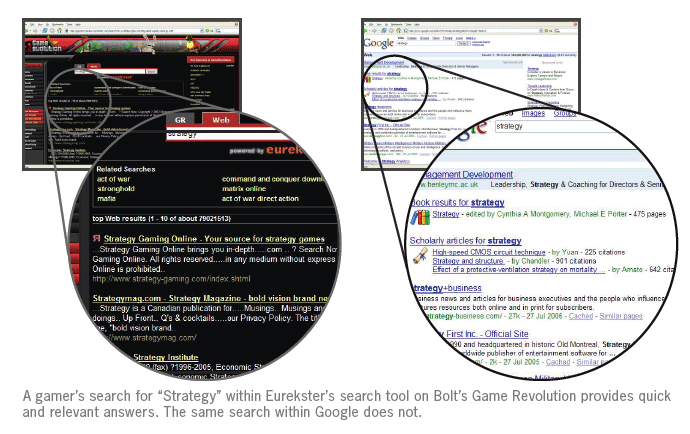
I came across this cool little social search engine the other day, Eurekster. What's different about Eurekster compared to the other search engines out there on the web? It allows YOU to create what they call "swikis" to search what you want to search for.

What is a swiki? Just think of it as a natural extension of personal publishing on the web...very much like a blog, podcast, or personal webpage. The unique thing about this search engine is that it's community powered, meaning that the engine you create begins to learn from its community of users as they search. Moreover, as the creator of the swiki, you can choose which websites to exclude or "promote" in the search results as they pertain to the relevancy of the community that you're trying to establish.

The premise behind Eurekster is simple: let publishers of web content, communities, and communication services offer more relevant search to their audiences and "to earn their share of the $5 billion paid search and advertising market." I'm a much more visual learner than the average person, so it might help you to see this tool in action. I picked a popular swiki on the main site of Eurekster for video games (at the risk of labeling myself a geek). You can either search for something unique by typing a keyword in the search box, or picking from the "hot searches" box. You can even compare search results to the same search on Google.

A cool web tool? Most definitely. Can it be used as a professional tool for recruiters or HR departments? That's still up in the air. There's definitely potential though, which is why I'm going to be tinkering around with this thing until I can find some use for it. ;)