I ran across this little tool just now, and couldn't resist posting it up here. What is it? It's a webtool that allows you to view the PageRank (Google) of links visually rather than in text on a particular domain.
I'll leave it up to you to figure out how this helps your life. ;)
Thursday, April 20, 2006


Firing Back
It's always interesting to see once-invincible titans of industry get passed by fresh upstarts every now and then. It's the age old tale of David vs. Goliath. Except in business, Goliath typically gets so big that they are slow to move on new ideas and technology...whereupon David enters the picture and is able to sidestep everyone in the industry with a "WOW" idea.
What's even more interesting than that?
When these titans attempt to fire back on these young upstarts to "protect their turf."
I came across this little news tidbit that claims AOL is joining the social networking foray that is currently dominated by MySpace. In fact, it appears AOL isn't even being shy about confronting MySpace "head on."
As comedian Russell Peters likes to say, "somebody gonna get a hurt real bad."
It'll be interesting to see who comes out on top for this one.
What's even more interesting than that?
When these titans attempt to fire back on these young upstarts to "protect their turf."
I came across this little news tidbit that claims AOL is joining the social networking foray that is currently dominated by MySpace. In fact, it appears AOL isn't even being shy about confronting MySpace "head on."
As comedian Russell Peters likes to say, "somebody gonna get a hurt real bad."
It'll be interesting to see who comes out on top for this one.
Tuesday, April 18, 2006
Offshore Teams: The Next Big Thing?
I've noticed an interesting thing while working in US-based organizations that utilize offshore teams: somehow, it's always the offshore team that's vilified for stuff that goes wrong (and there's always something that goes wrong).
In recruiting, the most often use of offshore teams tends to be in what has traditionally been called "research and sourcing" (I dislike that name, which is one of the reasons why I've re-branded it Talent Research within my company). I've also seen organizations delegate more process-oriented work to their offshore counterparts.
In nearly every case, I've heard the US-based organization complain about their offshore team's incompetence. "They aren't sending me the right candidates" is a typical lament. "Why are they sending me rodeo clowns when I obviously want bozos" is another one. "They just don't pay attention to the details"...you get the idea.
And yet, I have a hard time imagining how these offshore teams are THAT incompetent. I will admit that sometimes offshore teams just aren't up to fluff. However, I still argue that it's ultimately the US-based organization's fault--after all, they're the ones that put that team together.
This whole situation is a little ironic to me. You see, what it boils down to is our unwillingness to devote time to develop these offshore teams to the level of "competence" we want. Once we have a team in place, we (the mighty US multi-national) expect the offshore team to automatically overcome language barriers, cultural differences, and other idiosyncracies in business and provide "great" deliverables.
This approach has obviously failed. Many times. And yet, companies continue to do this.
Why is it ironic? Because as I've ranted before, the next big thing in business is going to be Talent Development. As more and more organizations begin to realize that there simply aren't enough people with "perfect" experiences...developing "raw" talent is going to become ever so important on the corporate agenda list.
And yet...here are these same organizations...unwilling to put aside time to develop offshore talent.
Don't get me wrong. I'm sure there are great examples of organizations that have made remarkable strides in utilizing offshore teams (and I'd love to hear about them). These are the "WOW" companies.
Right now, I'm simply addressing the unremarkable companies.
In recruiting, the most often use of offshore teams tends to be in what has traditionally been called "research and sourcing" (I dislike that name, which is one of the reasons why I've re-branded it Talent Research within my company). I've also seen organizations delegate more process-oriented work to their offshore counterparts.
In nearly every case, I've heard the US-based organization complain about their offshore team's incompetence. "They aren't sending me the right candidates" is a typical lament. "Why are they sending me rodeo clowns when I obviously want bozos" is another one. "They just don't pay attention to the details"...you get the idea.
And yet, I have a hard time imagining how these offshore teams are THAT incompetent. I will admit that sometimes offshore teams just aren't up to fluff. However, I still argue that it's ultimately the US-based organization's fault--after all, they're the ones that put that team together.
This whole situation is a little ironic to me. You see, what it boils down to is our unwillingness to devote time to develop these offshore teams to the level of "competence" we want. Once we have a team in place, we (the mighty US multi-national) expect the offshore team to automatically overcome language barriers, cultural differences, and other idiosyncracies in business and provide "great" deliverables.
This approach has obviously failed. Many times. And yet, companies continue to do this.
Why is it ironic? Because as I've ranted before, the next big thing in business is going to be Talent Development. As more and more organizations begin to realize that there simply aren't enough people with "perfect" experiences...developing "raw" talent is going to become ever so important on the corporate agenda list.
And yet...here are these same organizations...unwilling to put aside time to develop offshore talent.
Don't get me wrong. I'm sure there are great examples of organizations that have made remarkable strides in utilizing offshore teams (and I'd love to hear about them). These are the "WOW" companies.
Right now, I'm simply addressing the unremarkable companies.
Monday, April 17, 2006
Kan't Zpell? Try Orangoo.

For all you aspiring bloggers, here's a cool little tool I came across this morning. You're reading the first posting here that used Orangoo's application.
So does anyone else doubt that we're in the "Age of Creation Intensification?" Web 2.0, you have officially become the catalyst for this new era.
Here's the question: which one of the Big 3 (Google, Yahoo!, MSN) is going to look at this thing and try to either 1) Copy it or 2) Buy it?
Friday, April 14, 2006
Idiotic Product Design

I've been on the road for the past couple of days, and there's one thing that I've decided I can't live without: smartphones.
The problem is, I don't have one.
But after lugging around a 6 pound laptop with a battery that lasts no longer than it takes me to type this blog, I've come to the realization that carrying a smartphone would have allowed me to pack ridiculously lighter. It would have also saved me the irritation of having to sit next to a power outlet at the airport. (For those wondering, my laptop isn't ancient; it's a new Sony VAIO)
Or perhaps it's not the fact that I need a smartphone at all. Maybe I just need a better designed laptop.
This is what happens when you have bad product design: you get customers who begin to wonder how much life would be easier with SOMEthing else.
End rant.
Monday, April 10, 2006
The Growth of an Organization
By now we're all familiar with Google's meteoric rise. Their formula was pretty simple: take a simple concept (search) and then make it free to the masses. Once the masses become addicted to it ("hey, Google it"), charge corporations advertising fees using an innovative scheme.
As with all organizations, Google is beginning to look at other growth opportunities outside its core function. Check out this interesting alliance between BearingPoint and Google. Wonder if this is a blueprint for what Google would like to do in the future for the corporate world? It'll be interesting to see if this thing takes off with BearingPoint...
As with all organizations, Google is beginning to look at other growth opportunities outside its core function. Check out this interesting alliance between BearingPoint and Google. Wonder if this is a blueprint for what Google would like to do in the future for the corporate world? It'll be interesting to see if this thing takes off with BearingPoint...
Friday, April 07, 2006
The Age of Creation Intensification
I recently mentioned Murakami Teruyasu's prediction that we're shifting from an Age of Information Intensification to an Age of Creation Intensification. As you can probably tell, I agree with this theory.
Why? Check out this story. And this site. When 15 year old kids are creating things that actually address legitimate business needs, you KNOW something's about to happen.
All of this boils down to what I've been ranting about for a while: like it or not, younger kids are going to be the leaders of this new age we're about to step into. The Baby Boom generation had its moment in the spotlight. As they begin to retire in the next 5-15 years, it's the young ones that will be taking over in increasing numbers. And it's the young ones that will be asked to handle leadership tasks sooner than any other generation previous to them.
We all see the signs: technology is increasing efficiency more than ever, outsourcing is here to stay, and the pace of business is getting faster by the second. In order for the US to remain on top of the developed world, we'll need people (in increasing numbers as the Baby Boomers retire) who are capable of "architecting" and managing ever complex organizations and situations/problems. In essence, the business world is going to be handed to the "knowledge workers."
Which makes me think: in this new age, recruiting might not be the key to the War for Talent after all. It might be the first step in the important process (the MOST important process that a company will ever do), but not the most important. Rather, I think (more than ever) that an organization's ability to DEVELOP its talent will be the key to this whole thing. Put another way, an organization's ability to take raw talent and create the all-stars that it will need...THAT will be the single most important thing in the coming years.
Yes, coming from someone who is in the recruiting industry, that might sound blasphemous. But at the same time, doesn't it make it that much more powerful?
It's one of the reasons why I refuse to accept that recruiting and HR cannot co-exist together under the same department. Having the two functions work separately on their own little islands is a one way ticket to irrelevance in my mind.
Why? Check out this story. And this site. When 15 year old kids are creating things that actually address legitimate business needs, you KNOW something's about to happen.
All of this boils down to what I've been ranting about for a while: like it or not, younger kids are going to be the leaders of this new age we're about to step into. The Baby Boom generation had its moment in the spotlight. As they begin to retire in the next 5-15 years, it's the young ones that will be taking over in increasing numbers. And it's the young ones that will be asked to handle leadership tasks sooner than any other generation previous to them.
We all see the signs: technology is increasing efficiency more than ever, outsourcing is here to stay, and the pace of business is getting faster by the second. In order for the US to remain on top of the developed world, we'll need people (in increasing numbers as the Baby Boomers retire) who are capable of "architecting" and managing ever complex organizations and situations/problems. In essence, the business world is going to be handed to the "knowledge workers."
Which makes me think: in this new age, recruiting might not be the key to the War for Talent after all. It might be the first step in the important process (the MOST important process that a company will ever do), but not the most important. Rather, I think (more than ever) that an organization's ability to DEVELOP its talent will be the key to this whole thing. Put another way, an organization's ability to take raw talent and create the all-stars that it will need...THAT will be the single most important thing in the coming years.
Yes, coming from someone who is in the recruiting industry, that might sound blasphemous. But at the same time, doesn't it make it that much more powerful?
It's one of the reasons why I refuse to accept that recruiting and HR cannot co-exist together under the same department. Having the two functions work separately on their own little islands is a one way ticket to irrelevance in my mind.
Thursday, April 06, 2006
Feelin' Too Busy?

If you're one of those people who just can't seem to find enough time in a single day...I welcome you to this creation I just came across.
Makes you wonder...are people living too fast? Maybe the best thing to do in this Age of Creation Intensification is to slow things down a bit. Maybe then we'll actually be able to think.
Behold...the Future of Advertising

As you all know, Web 2.0 is in full force. Whether you've embraced the term or hate it, the reality is that new business models are popping up on the Internet every single day. Of course, most of them are doomed to failure, but there are some intriguing ones that if done right, could actually alter industries.
Here is the newest tool for aspiring companies trying to gain the attention of the masses: Spot Runner. It's still in "beta" (as all these Web 2.0 things are)...which basically means they're still working out the kinks in their business model in order to actually churn a profit after year 10.
So what's Spot Runner? It allows businesses to place 30 second TV commercials during prime time. Want to run a commercial on ESPN during SportsCenter? It costs as low as $44.
A very cool concept...granted, it still costs money to make a fairly decent commercial nowadays. But being able to afford prime time TV spots just might alter the way small businesses market themselves in the future.
For those that thought mighty Fortune 500 firms couldn't be defeated by small 5 person organizations...welcome to the "Era of Creation Intensification" (as Teruyasu Murakami would say). And say goodbye to the "Era of Information Intensification."
Tuesday, April 04, 2006
Are You Feeling the Net?

Here's a cool little tool from a company called Netvibes. What's so cool about their service? It lets you customize your own "web page," where you can put things such as RSS feeds, frequently visited sites, and anything else at your leisure. And as any new Web 2.0 tool, you can access this page anywhere as long as you have an Internet connection.
But the thing that I'm looking forward to: if this site catches on with people, it could be a very cool tool in the researcher's utility belt. Why? A "search for feeds" ability is currently in the works...
Is Jigsaw Really Evil?
We all know people have strong feelings. Especially when it comes to products or services that companies offer to the public. Ever bump into someone who swears by Apple? What about someone who loathes Bill Gates and all his evil empire ways? (I think Google is beginning to replace Microsoft as the new evil empire, but I digress...)
So I came across this one posting on Techcrunch that basically villifies Jigsaw. Jigsaw is one of those tools that many business people (and recruiters) use to connect to others all over the world. But according to the author of this blog, it's evil.
Which makes me wonder...what other tools out there are evil? :o
So I came across this one posting on Techcrunch that basically villifies Jigsaw. Jigsaw is one of those tools that many business people (and recruiters) use to connect to others all over the world. But according to the author of this blog, it's evil.
Which makes me wonder...what other tools out there are evil? :o
Monday, April 03, 2006
Are You A Heyoka?
Today's posting actually appears on Jim Stroud's blog site. For those of you not in the know, Jim is a member of the Elite Cybersleuthing community, and a good guy all around. If you guys are ever curious about what's going on in the recruiting industry, his blog is a must read...and no, I promise he's not paying me on the side for saying that! ;)
Friday, March 31, 2006
The Secret Talent Pool

I came upon this interesting article the other day.
According to a study by the Consumer Electronics Association, one third of adult gamers spend 10 hours or more per week playing games. I don't know about you, but that figure is a lot higher than I expected. Another surprising statistic? 58% of teen females play online games. In an industry traditionally dominated by the male sex, this figure is certainly surprising.
...this might be another talent pool that organizations start looking into. Of course, I'm not encouraging that since the last thing people want to see is recruiters start infiltrating the gaming forums. It can be done tastefully of course, but organizations have to tread carefully...
Thursday, March 30, 2006
Scary Research Tactics
I meant to post this last week when I happened upon this article, but as often happens...life just gets hectic sometimes.
Check out this link.
Can you imagine if any evil recruiters got their hands on this when the flaw was discovered? The horror...the horror...
Check out this link.
Can you imagine if any evil recruiters got their hands on this when the flaw was discovered? The horror...the horror...
Wednesday, March 29, 2006
The Future of Recruiting = The Modern Sports Organization

Here’s a thought. What if recruiting evolved into what has happened in the sports world? What if due to the talent shortage in the workforce, recruiters were forced to start tracking students while they were in high school?
You look at how NBA scouts have progressed from evaluating college talent…to watching high school talent…and now, they are beginning to “drop” by middle school games. Why? NBA organizations value talent. To them, keeping track of these kids as early as possible gives them an “edge” against other organizations who don’t. You know the ins and outs of the individual. You know what they like. What they don’t like. You know what they can do…and what they might eventually be able to do. NBA organizations keep track of all this stuff because you never know when the next LeBron James, Kobe Bryant, or Tim Duncan is going to come along.
An extreme scenario…but is it really that far off for the business world? Corporations have begun to assemble competitions among business school students in increasing numbers. Do you think they do this for the heck of it? No. It’s a way to scope out potential talent at the university level.
Some companies have taken it further. They have high school competitions. Again, it’s conceivable that many have used these competitions with an eye towards the future.
Any thoughts?
Friday, March 03, 2006
Eureka!!...I mean, Eurekster!!
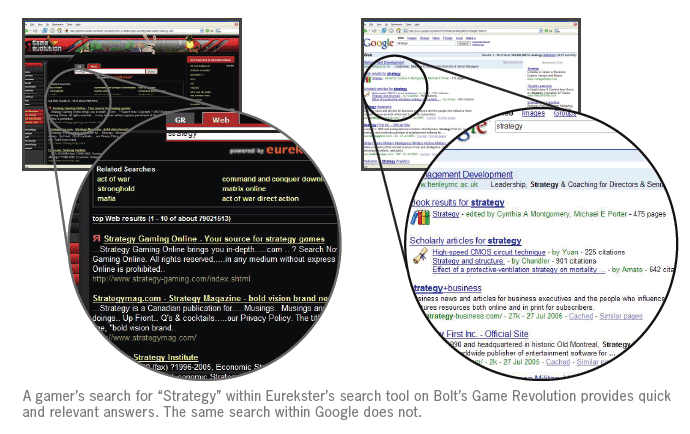
I came across this cool little social search engine the other day, Eurekster. What's different about Eurekster compared to the other search engines out there on the web? It allows YOU to create what they call "swikis" to search what you want to search for.
What is a swiki? Just think of it as a natural extension of personal publishing on the web...very much like a blog, podcast, or personal webpage. The unique thing about this search engine is that it's community powered, meaning that the engine you create begins to learn from its community of users as they search. Moreover, as the creator of the swiki, you can choose which websites to exclude or "promote" in the search results as they pertain to the relevancy of the community that you're trying to establish.
The premise behind Eurekster is simple: let publishers of web content, communities, and communication services offer more relevant search to their audiences and "to earn their share of the $5 billion paid search and advertising market." I'm a much more visual learner than the average person, so it might help you to see this tool in action. I picked a popular swiki on the main site of Eurekster for video games (at the risk of labeling myself a geek). You can either search for something unique by typing a keyword in the search box, or picking from the "hot searches" box. You can even compare search results to the same search on Google.
A cool web tool? Most definitely. Can it be used as a professional tool for recruiters or HR departments? That's still up in the air. There's definitely potential though, which is why I'm going to be tinkering around with this thing until I can find some use for it. ;)
Friday, February 17, 2006
The End of An Era...Part 2: Something's Gotta Give

I have a prediction (this may not be a new prediction, so bear with me in my ignorance): in the next five to ten years, organizations will increasingly be forced to put younger employees in positions that demand more responsibility than previous generations before them in the same roles. Put another way, organizations that want to survive in this New Economy must begin placing younger talent in “stretch” roles to ensure a solid foundation for the future.
For me, there are no “if” “ands” or “buts” about this statement. The Baby Boom Generation’s gradual retirement over the next 10 -15 years is inevitable. And so is the fact that at the end of the day, there will be anywhere from 30 to 40 million less workers by that time in the
Something’s gotta give.
This will be part of an ongoing “series” of rants for me, so I’ll gradually speak about all the ramifications of the above statement I just made. For today, I want to address one aspect of how companies view candidates interviewing for open opportunities.
Let’s start at the beginning. The typical company usually opens a job requisition when there is an available position somewhere. Once that job requisition (or “req.” as it’s so often called) is opened, recruiters usually huddle with the hiring managers involved and discuss the details of the position. After this, the green light is given and it’s all systems go. The recruiter begins to scour the corners of the Earth looking for the perfect candidate, while the hiring manager tries to balance their work load with interviewing candidates that pass through the screening process.
In my personal opinion, though, there’s a BIG disconnect in this whole process. It’s at the point where the recruiter and hiring manager huddle together to discuss the “details.” Experience, educational background, communications skills…all of these (and many more) things end up being discussed at some point in the process. That’s not the problem. The problem is the lens through which the recruiter and hiring manager are evaluating these prospective candidates.
You see, recruiters and hiring managers (more often than not) look for someone who “fits” the description they’ve laid out for the position. They have to have 6-10 years of experience…possess an MBA degree from a top ten school…come from a top competitor…and so on and so forth. If candidates don’t possess these minimum qualifications, they’re usually given the boot. Especially if the organization is a reputable one that has a good brand name.
My point? Talent for a particular job doesn’t always necessarily “fit” the description the company has laid out. In fact, I’d argue that in a lot of cases, some of the most talented people for the position wouldn’t even come close to “fitting” the description.
Some examples:
Steve Jobs – The iPod guy. Do you honestly think a sane company would have hired someone as CEO who dropped out of college after one semester? Forget hiring for the CEO spot. Do you think a brand name firm (like Intel) would have taken a chance to offer Jobs a full time role as a regular employee? This is the same guy that went to
Ben Wallace – Some of you might be scratching your heads on this one. Yes, he’s an athlete. A 4 time NBA All-Star to be exact. But it doesn’t change the fact that all organizations, sports or not, tend to filter candidates a certain way. Big Ben graduated from a no-name college. Went undrafted because teams thought he was too small for his position and scouts said he had no offensive game. Guess who’s laughing now?
Andy Stanley – Pastor of
These examples just go to show that sometimes, the best people for your organization won’t “fit” into the mold that you create for them. So the question is: will organizations begin to break the mold and see candidates in a whole new light? Moreover, will recruiters and the HR function as a whole learn to filter candidates so that the good ones don’t fall through the cracks?
As more and more Baby Boomers retire, I have a feeling that more and more organizations will be asking and telling themselves “is he/she ready for this type of role?”…”they don’t have enough experience”…”they don’t have the educational background we like”…etc. etc.
But like I said earlier, something’s gotta give.
Thursday, February 16, 2006
Random Musings

I haven't posted anything in a while...my apologies to all my readers (at this point, it's believed to be in the single digits still). Things have been quite hectic for me as of late, but I promise to post Part 2 of my "series" of rants very soon. In the meanwhile...
I came across this video clip on Garr Reynold's blog. Very cool.
Now what would be even cooler is applying this technology to candidate management systems. That's one system I would not mind using on a daily basis!
Sunday, January 29, 2006
The End of An Era...Part 1
As you can tell from my first post, I feel that HR is long overdue for some major overhauling. As someone with a business school background, I look at the HR function and see a department that in some ways has lost touch with the rest of the business world.
While the majority of the business world has changed with the times, it seems HR has been stuck in a rut for the last decade (or even longer). What do I mean by this? If you look at other business functions like marketing, manufacturing, IT, or management (among a slew of others), they have evolved as the market has demanded. More than ever, organizations are focused on solutions…experiences…”dream fulfillment”…brands that inspire…design…and WOW projects.
As a result, there is more and more press on how organizations are “thinking outside the box.” The way I translate this: more than ever, organizations are willing to take risks on the intellectual capital (read: Talented people) within their walls. In the past, large corporate entities were hesitant to hand over anything significant to the “risk takers” who wanted to go against the grain. It was “safer” to instead make incremental improvements that management teams suggested after thorough “analysis.”
But times have changed. As I said in my previous post, we live in an Age of Talent. But the catalyst to this age has been disruption in the business world. Organizations find themselves having to compete in a global landscape against competitors that didn’t even exist six months ago. Witnessing the quick rise of Google should tell you that this disruption is a new reality…a new constant in this age.
Now organizations are finding themselves becoming more and more reliant on the group of people they once ignored. It’s the creative, the nutty, and the risk taking individuals who are helping to push organizations ahead of their competitors. In short, it’s a new breed of intellectual capital that’s helping to open up new markets for these large firms. The “White-Collar Revolution” (as Tom Peters calls it) has officially begun.
Tom Kelley, founder of the acclaimed design firm IDEO, addressed the new collective spirit of this movement fittingly when he said, “weed out the dullards, nurture the nuts.”
This is where the staid HR department comes in.
HR needs more nuts. It’s the only way we can survive in an era when change and disruption are the constant. It’s the only way we can finally begin to pay Talent its due, rather than giving it lip service.
Tuesday, January 24, 2006
Let's get it started...
This marks my inaugural post here on Beyond HR. What is Beyond HR? It's a space that is dedicated to revolutionizing the human resources industry. In addition, I'll do my best to convey the latest HR trends, ideas, technologies, and tactics through as unique a lens as possible.
I could go on and on about what a revolution means. But I think you get the point. Besides, if I included everything from the get go, I'd have nothing to write about in the future. ;)
My hope is that some of the things I have just written resonated within you. And if they have...join me in trying to change the status quo...and start a revolution. It all starts here.
So what do I mean by "revolutionize HR?" It means...
...coming up with a new name for human resources. Some of you may say it's just semantics, but to me the "human resources department" just does not inspire. When's the last time you heard HR and excitement in the same sentence from someone OUTside the HR department? Changing the status quo sometimes means using different words to begin shifting people's perspective away from the old, and on to the new.
...destroying the way corporations think about HR. Rather than make HR into a paper pushing department concerned with tasks like benefits and payroll, I want to start seeing organizations utilize HR to "quarterback" the War for Talent.
...taking the War for Talent seriously. This phenomenon has been paid so much lip service over the last couple of years, but I have yet to see more than a handful of organizations put the money where their mouth is. We're witnessing a shift towards a New Age right now. What is it? The Age of Talent. I'm convinced that old tactics such as TQM (total quality management), CI (continuous improvement), and the balanced scorecard (as well as many others) will not be enough to help organizations thrive in the coming years. What does that mean? The sole differentiator between excellence and mediocrity in an industry will be Talent.
...redefining job descriptions and job requisitions. I hate both of them. The reason I hate both of them is the same reason I hate the "human resources" name. They don't inspire. They don't excite. They don't evoke passion. When's the last time that you met a Talented person who doesn't exhibit these three qualities? Then why do we insist on using tools that don't speak the same language?
...changing the way the HR industry "views" Talent. Some recruiters don't think every person has Talent. Some recruiters believe everyone has some ounce of Talent. At the very root of the issue is: WE HAVE NO CLUE WHAT TALENT IS. And it scares us as HR professionals. So we avoid the issue by concentrating on stuff like years of experience, knowledge acquired, and educational background. I want to see this industry begin taking measures to define what Talent means...how Talent will elevate your firm to unprecedented heights...how you will attract Talent...how you will develop Talent in-house...and most importantly, how you will retain Talent.I could go on and on about what a revolution means. But I think you get the point. Besides, if I included everything from the get go, I'd have nothing to write about in the future. ;)
My hope is that some of the things I have just written resonated within you. And if they have...join me in trying to change the status quo...and start a revolution. It all starts here.
Subscribe to:
Posts (Atom)