Friday, March 31, 2006

The Secret Talent Pool


I came upon this interesting article the other day.

According to a study by the Consumer Electronics Association, one third of adult gamers spend 10 hours or more per week playing games. I don't know about you, but that figure is a lot higher than I expected. Another surprising statistic? 58% of teen females play online games. In an industry traditionally dominated by the male sex, this figure is certainly surprising.

...this might be another talent pool that organizations start looking into. Of course, I'm not encouraging that since the last thing people want to see is recruiters start infiltrating the gaming forums. It can be done tastefully of course, but organizations have to tread carefully...

Thursday, March 30, 2006

Scary Research Tactics

I meant to post this last week when I happened upon this article, but as often happens...life just gets hectic sometimes.

Check out this link.

Can you imagine if any evil recruiters got their hands on this when the flaw was discovered? The horror...the horror...

Wednesday, March 29, 2006

The Future of Recruiting = The Modern Sports Organization


Here’s a thought. What if recruiting evolved into what has happened in the sports world? What if due to the talent shortage in the workforce, recruiters were forced to start tracking students while they were in high school?

You look at how NBA scouts have progressed from evaluating college talent…to watching high school talent…and now, they are beginning to “drop” by middle school games. Why? NBA organizations value talent. To them, keeping track of these kids as early as possible gives them an “edge” against other organizations who don’t. You know the ins and outs of the individual. You know what they like. What they don’t like. You know what they can do…and what they might eventually be able to do. NBA organizations keep track of all this stuff because you never know when the next LeBron James, Kobe Bryant, or Tim Duncan is going to come along.

An extreme scenario…but is it really that far off for the business world? Corporations have begun to assemble competitions among business school students in increasing numbers. Do you think they do this for the heck of it? No. It’s a way to scope out potential talent at the university level.

Some companies have taken it further. They have high school competitions. Again, it’s conceivable that many have used these competitions with an eye towards the future.

Any thoughts?

Friday, March 03, 2006

Eureka!!...I mean, Eurekster!!


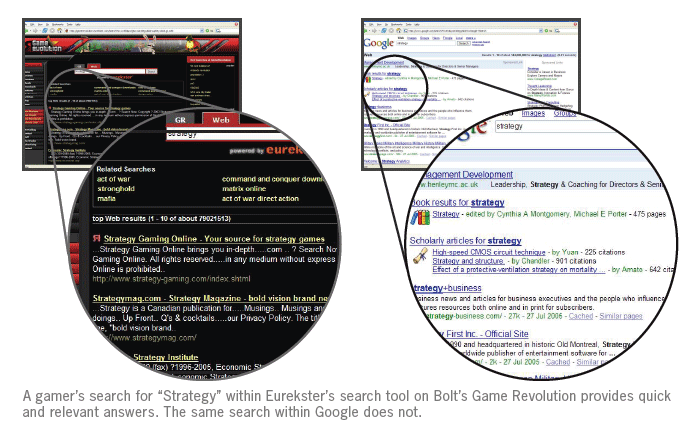
I came across this cool little social search engine the other day, Eurekster. What's different about Eurekster compared to the other search engines out there on the web? It allows YOU to create what they call "swikis" to search what you want to search for.

What is a swiki? Just think of it as a natural extension of personal publishing on the web...very much like a blog, podcast, or personal webpage. The unique thing about this search engine is that it's community powered, meaning that the engine you create begins to learn from its community of users as they search. Moreover, as the creator of the swiki, you can choose which websites to exclude or "promote" in the search results as they pertain to the relevancy of the community that you're trying to establish.

The premise behind Eurekster is simple: let publishers of web content, communities, and communication services offer more relevant search to their audiences and "to earn their share of the $5 billion paid search and advertising market." I'm a much more visual learner than the average person, so it might help you to see this tool in action. I picked a popular swiki on the main site of Eurekster for video games (at the risk of labeling myself a geek). You can either search for something unique by typing a keyword in the search box, or picking from the "hot searches" box. You can even compare search results to the same search on Google.

A cool web tool? Most definitely. Can it be used as a professional tool for recruiters or HR departments? That's still up in the air. There's definitely potential though, which is why I'm going to be tinkering around with this thing until I can find some use for it. ;)

Friday, February 17, 2006

The End of An Era...Part 2: Something's Gotta Give


I have a prediction (this may not be a new prediction, so bear with me in my ignorance): in the next five to ten years, organizations will increasingly be forced to put younger employees in positions that demand more responsibility than previous generations before them in the same roles. Put another way, organizations that want to survive in this New Economy must begin placing younger talent in “stretch” roles to ensure a solid foundation for the future.

For me, there are no “if” “ands” or “buts” about this statement. The Baby Boom Generation’s gradual retirement over the next 10 -15 years is inevitable. And so is the fact that at the end of the day, there will be anywhere from 30 to 40 million less workers by that time in the US.

Something’s gotta give.

This will be part of an ongoing “series” of rants for me, so I’ll gradually speak about all the ramifications of the above statement I just made. For today, I want to address one aspect of how companies view candidates interviewing for open opportunities.

Let’s start at the beginning. The typical company usually opens a job requisition when there is an available position somewhere. Once that job requisition (or “req.” as it’s so often called) is opened, recruiters usually huddle with the hiring managers involved and discuss the details of the position. After this, the green light is given and it’s all systems go. The recruiter begins to scour the corners of the Earth looking for the perfect candidate, while the hiring manager tries to balance their work load with interviewing candidates that pass through the screening process.

In my personal opinion, though, there’s a BIG disconnect in this whole process. It’s at the point where the recruiter and hiring manager huddle together to discuss the “details.” Experience, educational background, communications skills…all of these (and many more) things end up being discussed at some point in the process. That’s not the problem. The problem is the lens through which the recruiter and hiring manager are evaluating these prospective candidates.

You see, recruiters and hiring managers (more often than not) look for someone who “fits” the description they’ve laid out for the position. They have to have 6-10 years of experience…possess an MBA degree from a top ten school…come from a top competitor…and so on and so forth. If candidates don’t possess these minimum qualifications, they’re usually given the boot. Especially if the organization is a reputable one that has a good brand name.

My point? Talent for a particular job doesn’t always necessarily “fit” the description the company has laid out. In fact, I’d argue that in a lot of cases, some of the most talented people for the position wouldn’t even come close to “fitting” the description.

Some examples:

Steve Jobs – The iPod guy. Do you honestly think a sane company would have hired someone as CEO who dropped out of college after one semester? Forget hiring for the CEO spot. Do you think a brand name firm (like Intel) would have taken a chance to offer Jobs a full time role as a regular employee? This is the same guy that went to India and came back with a shaved head and traditional Indian clothing when he went back to work for Atari.

Ben Wallace – Some of you might be scratching your heads on this one. Yes, he’s an athlete. A 4 time NBA All-Star to be exact. But it doesn’t change the fact that all organizations, sports or not, tend to filter candidates a certain way. Big Ben graduated from a no-name college. Went undrafted because teams thought he was too small for his position and scouts said he had no offensive game. Guess who’s laughing now?

Andy Stanley – Pastor of North Point Community Church. Again, try to view this from an organizational bias perspective. Andy was a mediocre student in high school. He went on to an average university, where he admittedly wasn’t a candidate for any academic distinctions (except for maybe the bad kind). His parents even worried about him at many points along his collegiate “career.” And now…he’s the leader of one of the most influential churches in the US. Business leaders have recognized his leadership abilities, and his ability to connect to large audiences when speaking. He even came up with a new term to address what everyone in this world needs: “visioneering.”

These examples just go to show that sometimes, the best people for your organization won’t “fit” into the mold that you create for them. So the question is: will organizations begin to break the mold and see candidates in a whole new light? Moreover, will recruiters and the HR function as a whole learn to filter candidates so that the good ones don’t fall through the cracks?

As more and more Baby Boomers retire, I have a feeling that more and more organizations will be asking and telling themselves “is he/she ready for this type of role?”…”they don’t have enough experience”…”they don’t have the educational background we like”…etc. etc.

But like I said earlier, something’s gotta give.

Otherwise, a lot of organizations are going to find themselves looking up at competition that they previously looked down upon. And it’s because that competition figured out that sometimes, you have to take chances on people who don’t “fit” perfectly…and invest the proper time and energy to make sure they succeed in these “stretch” roles.

Thursday, February 16, 2006

Random Musings


I haven't posted anything in a while...my apologies to all my readers (at this point, it's believed to be in the single digits still). Things have been quite hectic for me as of late, but I promise to post Part 2 of my "series" of rants very soon. In the meanwhile...

I came across this video clip on Garr Reynold's blog. Very cool.

Now what would be even cooler is applying this technology to candidate management systems. That's one system I would not mind using on a daily basis!

Sunday, January 29, 2006

The End of An Era...Part 1

As you can tell from my first post, I feel that HR is long overdue for some major overhauling. As someone with a business school background, I look at the HR function and see a department that in some ways has lost touch with the rest of the business world.

While the majority of the business world has changed with the times, it seems HR has been stuck in a rut for the last decade (or even longer). What do I mean by this? If you look at other business functions like marketing, manufacturing, IT, or management (among a slew of others), they have evolved as the market has demanded. More than ever, organizations are focused on solutions…experiences…”dream fulfillment”…brands that inspire…design…and WOW projects.

As a result, there is more and more press on how organizations are “thinking outside the box.” The way I translate this: more than ever, organizations are willing to take risks on the intellectual capital (read: Talented people) within their walls. In the past, large corporate entities were hesitant to hand over anything significant to the “risk takers” who wanted to go against the grain. It was “safer” to instead make incremental improvements that management teams suggested after thorough “analysis.”

But times have changed. As I said in my previous post, we live in an Age of Talent. But the catalyst to this age has been disruption in the business world. Organizations find themselves having to compete in a global landscape against competitors that didn’t even exist six months ago. Witnessing the quick rise of Google should tell you that this disruption is a new reality…a new constant in this age.

Now organizations are finding themselves becoming more and more reliant on the group of people they once ignored. It’s the creative, the nutty, and the risk taking individuals who are helping to push organizations ahead of their competitors. In short, it’s a new breed of intellectual capital that’s helping to open up new markets for these large firms. The “White-Collar Revolution” (as Tom Peters calls it) has officially begun.

Tom Kelley, founder of the acclaimed design firm IDEO, addressed the new collective spirit of this movement fittingly when he said, “weed out the dullards, nurture the nuts.”

This is where the staid HR department comes in.

HR needs more nuts. It’s the only way we can survive in an era when change and disruption are the constant. It’s the only way we can finally begin to pay Talent its due, rather than giving it lip service.

Tuesday, January 24, 2006

Let's get it started...

This marks my inaugural post here on Beyond HR. What is Beyond HR? It's a space that is dedicated to revolutionizing the human resources industry. In addition, I'll do my best to convey the latest HR trends, ideas, technologies, and tactics through as unique a lens as possible.

So what do I mean by "revolutionize HR?" It means...

...coming up with a new name for human resources. Some of you may say it's just semantics, but to me the "human resources department" just does not inspire. When's the last time you heard HR and excitement in the same sentence from someone OUTside the HR department? Changing the status quo sometimes means using different words to begin shifting people's perspective away from the old, and on to the new.

...destroying the way corporations think about HR. Rather than make HR into a paper pushing department concerned with tasks like benefits and payroll, I want to start seeing organizations utilize HR to "quarterback" the War for Talent.

...taking the War for Talent seriously. This phenomenon has been paid so much lip service over the last couple of years, but I have yet to see more than a handful of organizations put the money where their mouth is. We're witnessing a shift towards a New Age right now. What is it? The Age of Talent. I'm convinced that old tactics such as TQM (total quality management), CI (continuous improvement), and the balanced scorecard (as well as many others) will not be enough to help organizations thrive in the coming years. What does that mean? The sole differentiator between excellence and mediocrity in an industry will be Talent.

...redefining job descriptions and job requisitions. I hate both of them. The reason I hate both of them is the same reason I hate the "human resources" name. They don't inspire. They don't excite. They don't evoke passion. When's the last time that you met a Talented person who doesn't exhibit these three qualities? Then why do we insist on using tools that don't speak the same language?

...changing the way the HR industry "views" Talent. Some recruiters don't think every person has Talent. Some recruiters believe everyone has some ounce of Talent. At the very root of the issue is: WE HAVE NO CLUE WHAT TALENT IS. And it scares us as HR professionals. So we avoid the issue by concentrating on stuff like years of experience, knowledge acquired, and educational background. I want to see this industry begin taking measures to define what Talent means...how Talent will elevate your firm to unprecedented heights...how you will attract Talent...how you will develop Talent in-house...and most importantly, how you will retain Talent.

I could go on and on about what a revolution means. But I think you get the point. Besides, if I included everything from the get go, I'd have nothing to write about in the future. ;)

My hope is that some of the things I have just written resonated within you. And if they have...join me in trying to change the status quo...and start a revolution. It all starts here.